Wednesday, June 29, 2011

Choosing an MFA Program: 10 Ideal Considerations

I’m sure you’ll have no trouble finding advice on how to choose an MFA program in creative writing, but it always strikes me as funny (in a sad kind of way!) how people who are in the process of selecting an MFA program often stop at two considerations: Can I afford it? and Can I get in? While these are certainly valid considerations, ideally you should not stop at these. MFA programs vary widely and choosing the right one can make a huge difference in how happy you are with the outcome. Below are some more things to think about.

1.     Don’t automatically discount the more expensive programs just because you think you can’t afford them. Too many people these days only think of two ways of paying for their education: up front, or with loans. Student loans are particularly scary, especially when used to pay for a degree not often seen as “lucrative,” like an MFA. Who wants to graduate with thousands of dollars in debt, only to face iffy job possibilities?

Loans are only one option, however. Take the time to investigate if you qualify for other types of aid, like scholarships, fellowships, grants, and assistantships. If you belong to any kind of minority at all, milk it for all it’s worth! There are lots of awards that are not need or merit based, should you belong to that marginal income bracket where you can’t afford school but are not “poor enough” to qualify for aid, or if your grades or test scores aren’t the best. By far, the best kind of financial assistance is a teaching assistantship. Let’s face it: while you’re working on your GAM (Great American Novel), you’re probably going to do some teaching to pay the bills, and the sooner you start racking up experience in front of a classroom, the better.

Maruchan Ramen, Creamy Chicken, 3-Ounce Packages (Pack of 24)
What you will be able to buy
with your stipend.
The irony is that it's usually the more expensive schools that offer options other than loans. Cheaper schools don’t often have the resources to provide their grad students with assistantships, so you’re forced to take out loans to go to a school you see as “cheaper,” when you could have gotten a better deal from a more expensive school. Assistantships usually come with tuition remission and a stipend, so not only are you getting teaching experience, but you’re going to school for free and making a small profit. Of course the first thing on your mind is being able to afford your education, but informing yourself on different options can make a huge difference in your possibilities even if cost is your first priority.

2.     Lots of people begin their search by looking at rankings, such as the Poets& Writers yearly list. True, there is a benefit to going to a prestigious school. People will be impressed, people who might have a role in publishing you and/or employing you. However, at the end of the day, it’s your writing that will make the impression, not where you graduated from, and, if you and that top school aren’t a good fit, all that prestige (and the big bucks that usually go with it) will go to waste. I’m not saying to ignore the issue of reputation; what I’m saying is, not to let it cloud your judgment to such a degree that you pass over a less prestigious school where you might have learned more. Schools have philosophies, and environments, faculty, all sorts of things that influence your success. I discuss what these are in greater detail below, but at this moment my point is this: choose the program that fits your needs first, whether or not it’s “top-ranked.”

3.     One of the first of these other-than-prestige factors you should consider is the program’s dominant genre. Most MFA programs offer classes in the three major genres: fiction, poetry, and creative nonfiction. Though they will claim that each has the same weight, it’s kind of clear that there’s usually one genre that becomes centric, if only for a couple of years. It gets the most students, the best faculty, the “buzz.” Nothing sucks more than being stuck in a program where there’s a poetry reading every week packed to the proverbial rafters with groupies, while you and “the other fiction students” huddle in the back trying to see if anyone would be interested in starting a protest. Get a feel for what the predominant genre might be by looking at the faculty and their publications, and at the classes offered. Which classes usually fill up fastest?

4.     Speaking of faculty. It’s incredible how often people overlook taking the faculty under consideration in their choice. Faculty is everything. If your only experience of being a student is a large, impersonal undergraduate course, you have no idea how crucial your relationship to the faculty will be in an MFA program. These people will become your gurus, your Yodas. Failure to “click” with the faculty will kill your MFA experience.
Lucas Film Cl0Ne Wars Jedi Yoda Pillow Buddy
Your thesis advisor, I
will be.

First, look for faculty whose writing you want to mimic. I know, I know, you want to be original and all that. Fine. But you are going to school to learn how the faculty writes. What they value, their process, their experience is the sole object of study. No, they probably won’t teach any of their own books. But what they will see in other’s writing, in your writing, is what they see in their own. Pr. A. is famous for her snappy dialogue, for example. In her workshop, you can bet that’s going to take center stage. Sure, you will discuss other elements of writing, like setting and characterization, but you will learn most about snappy dialogue. If you think snappy dialogue is the hallmark of the hack and you would rather die than be known for your snappy dialogue, this relationship is not going to work.

There are genres within genres. If the fiction faculty is dominated by realists and your dream is to write some post-postmodern novel with pages inserted backwards and a chapter in pictograms, you should go to a school where most of the fiction faculty agrees. If you are a lyric poet, don’t go to a school where all the poets are Language poets.

If possible, sit in on a class or at least try to meet the profs to get a feel for their personalities. A professor might be a great writer, but, if meeting him sends shivers down your spinethe wrong kind of shiversyou don’t want to work with him on your thesis, do you? Writing workshops are every much tiny cults of personality. Even when a professor does his best to decenter authority, it just can’t be helped. You should like the professor’s writing, and the professor’s persona. Often, these two are so intimately linked that, if you can’t do a campus visit, you can substitute reading the faculty’s work. Don’t like it? For all that is holy, do not go to that school. Conversely, if there is an author whose work you particularly admire, consider picking the program based on where she teaches. The AWP Official Guide to Writing Programs allows you to search for a program by faculty name.

5.     Which brings me to my next point: consider faculty size. The smaller the faculty, the more classes you will have to take with the same professor, and the more claustrophobic the relationship will be. This can be good if you get a great matcha true mentorship situation. But a small faculty has its drawbacks. No range, for one thing. Even if you pick one or two professors as your mentors, you really want to get a couple more perspectives. If you are considering a small school, do ask if they regularly have visiting professors. Visiting professors may not stay long enough to become mentors, but at least you’ll get a new voice in the choir.

6.     Also look at the literature and theory faculty. Lots of people overlook this point, but it’s actually quite important. Most MFA programssome more than othersrequire you to take courses outside creative writing in literature, theory, and another language. You are, after all, getting a graduate degree. If the non-creative writing faculty is a real dud, they can quickly make your MFA experience truly miserable. Too often, I hear creative writing students complain about required courses. This seems pretty immature and narcissistic to mewriters should love reading and studying the work of others. Your literature and theory courses should not be some kind of chore you have to put up with to get your MFA. They should be an opportunity to enrich your experience as a reader. Look for a charismatic lit and theory faculty that offers courses you might be interested in taking just as much as your workshops.

7.     Also look for quality in the students. One of the advantages of going to a prestigious program is that they are harder to get into, so your chances of being surrounded by other good writers are better. However, it’s no guarantee, and unfortunately it’s difficult to gauge the quality of students without a campus visit in which you can sit in on some classes. Ask about recent grads, and, if possible, read some of their work.

A good workshop experience is not solely based on the quality of the students’ writing, however, but on their enthusiasm and critical expertise. The best workshop leader in the world can’t salvage a workshop if the other members are duds. Perhaps the students are self-centered, and shut down when others’ work is being discussed. Perhaps they are such bad writers that they have nothing to contribute as critics.

Look for a lively, active student body. Are there frequent campus readings? What’s the graduation ratio? Is there . . . a “vibe”?

8.     Speaking of vibesdo look for diversity, especially if you are a woman or a minority. Unfortunately, discrimination exists, and nothing will kill your writing spirit more than having to deal with it. Both the faculty and the students in the program should reflect the diversity level you are comfortable with. Even if there is no blatant prejudice à la V.S. Naipaul, do you really want to be the only woman, the only Latina, or the only anything in the program? You might think it’ll be good preparation for the post-graduation “real world,” but a program in which you are surrounded by diversity can help you to grow as yourself, and not just as some kind of exception to an unstated norm. Fight discrimination laterfirst, learn to write.

9.     A program that has a journal attached can be of invaluable experience to those who wish to go into publishing as well as writing later. If you think you might want to do that, look for a program that offers its grad students opportunities to work on their journal.

10.  Finally, consider nontraditional MFA options, like low-residency programs and doctoral programs. The low-residency option is ideal for people who are tied up elsewhere. I don’t think that’s a good idea if you can help it, however. It’s hard for me to believe you can get the same experience long-distance. Part of the joy of grad school is how it isolates you and allows you to hyperfocus on your work while being surrounded by others just as obsessed with this one thing as you are. But it might be better to do a low-residency MFA with a great program somewhere you can’t get to than to settle for a so-so program where you are.

The PhD option is really catching fire. More and more programs now offer it. If you’re torn between two loverswriting and academiait’s perfect. Many programs are also now offering a generalized writing MA without the strict purpose of creative writing. If your other lover is journalism, advertising, or some other related field, these might be an interesting compromise.

The ultimate trick, of course, is taking your time. Begin your selection process at least a year before you plan on going, ideally two or even three. As with any degree, you’re not just choosing one programyou should have plenty of backup selections, so you can further select, from among those that actually accept you, the program that offers you the best deal not only in funding, but also in those other things you should consider, like housing and your own personal albatrosses such as family and hatred of snow. And, of course, remember that no decision is ever final. So you messed up. You hate everyone in your program, and they hate you back. Just transfer, baby. It’s an MFA, not a prison sentence!

Friday, June 17, 2011

Publish or Perish? Some Quick Thoughts on Submitting Your Work

I’ve had a couple of interesting conversations with other writers over the years about publishing. For a while, I felt like I had a great advantage over writers who are obliged to promote an academic career or an established reputation with a big-name publisher: I could choose to publish “wherever I wanted.” They, on the other hand, had to make distinctions that seemed to me impossible, among them the always tricky and ever-changing decision between print and online venues.

In just a few short years, the criteria for such a distinction have changed radically. Hardly any writers would toss down the blanket judgment of just a few years ago, i.e., that no online journal was “worth” being published in. Three simultaneous developments have made that once clear line between print and online journals nearly disappear. First, many once print-only journals have transitioned to online content. There is no such thing as a major journal that doesn’t at least have a website, and many very good journals have quite a bit of online only content while still maintaining a regular print issue. Second, there are also many journals—very good ones—that exist exclusively online, either because they started that way or because they abandoned the print format in favor of going digital. Finally, and this is the point that I don’t see enough people making, printing a very good looking paper journal has now become so easy and affordable that many people out there are doing it in vast, unregulated numbers. The guarantees hardcore print enthusiasts once associated with paper are no longer valid. A paper issue doesn’t necessarily mean you have the backing of a university, an established editorial board, or even a small press. It also doesn’t mean that you have a guaranteed readershipin fact, your work will probably be read by many more readers if you publish it online. A print issue can mean all these things, but it can also simply mean that someone has a good computer and has been visiting blurb.com.

So how do you decide where to send your work? Depends. If you have some kind of reputation you want to build or protect, you probably know how to answer this question better than I do. If you’re like me, however, you’re going to need some criteria, so here goes:

1.       Forget the print/online distinction. It is no longer valid. There’s good and bad on both sides of the great divide.
2.       Look at the number of issues. While it might be more challenging to get into an established journal, understand that a fledging one is a risk. Sadly, the market for readers is poor, and largely swallowed up by the big publishing houses. There’s little money to be made in keeping a journal going, and many of them go under in less than a year. If the journal is less than five years old, it’s a risk.
3.       Look at the title. If the journal doesn’t take itself seriously, why should you? Many times, you hear about a CFS (Call for Submissions) from a new journal or one you haven’t heard about. If it’s called Uncle Bob’s Dear Johnnies, that’s a joke, not a journal.
4.       Look at the editorial board. The better the journal, the more people will be involved. Usually there is an Editor in Chief, and separate editors for separate genres (Fiction, Poetry, Nonfiction Editor), followed by one or more Assistant Editors. Sometimes there’s one or more Guest Editors. Don’t recognize any names? That’s what Google is for. Someone who has fewer publications than you is not likely to make a good editor.
5.       Evaluate any university connection. Sometimes it’s a good thinga university connection means a reputation is at stake, and there’s financial backing, which together make for good work and possible longevity, especially if there is a creative writing program attached. However, be wary of those pop-up schools you’ve never heard of. These here today, gone tomorrow phlebotomist factories have nothing to do with academia and everything to do with commerce, so they’re not likely to put out a journal with good intentions. Luckily, these places don’t often do so. But there are also university-affiliated journals whose main focus is undergraduate work. Unless you’re an undergraduate yourself, you probably want to keep looking.
6.       The deal breaker is just like it was in high school. How did you decide whether to go to a party in high school? You remember. Your first question was, who else is going? Read the last issue of the journal you intend to submit to. If the writing is subpar in any way, don’t submit. You really want to be caught at the party full of geeks and dweebs? I don’t think so.

What I’m talking about here is respect. Respect your work, or no one else will. Sometimes, we’re so freaking desperate to get published that we feel it’s “publish or perish” even if no one else is breathing down our necks but us. Cave in to this desire, however, and you just might find yourself doing the literary equivalent of getting caught making out with the flute player at band camp. What’s the value of being published in a venue that no one will read and no one will appreciate? You might as well hand your writing out at the stop light along with the flyers for quick lube jobs and cheap divorces.

Speaking of respect. I don’t know about you, but I’m also not into submitting to places that are going to treat me like dirt, even if they are reputable (it does happen). I don’t expect to be paidcrappy as that situation is, I accept it as a problem with the market. But I do expect to be told if my work is rejected in a timely fashion. If I send some work out to a journal and six months go by with no reply, they’re dead to me. I don’t care how good they think they arethey have no right to keep me hanging on that long, even if I’m some nobody from the slush pile. There are many things editors can do, including closing submissions, if they’re swamped. Treating the writers who make up the pages of their journal like dirt is never an option.

I’ve written here exclusively about journals, but these thoughts could just as well apply to any venue for your writing. Submissions to anthologies and publishers are similar. Don’t send your work to a contest called “Uncle Bob’s Belly Picks.” You may stand a good chance of winning, but would you want to?

Choose the places you submit to carefully. If you’re not willing to read an entire issue, no one else will be.

Friday, June 10, 2011

Poetry Revision 101, Lesson Four: Do I Sound Fat in This Poem?

This post is dedicated to Dinkinish, who writes with an airbrush.

The wild roses are very red,
and the violets are dark blue,
while the sugar is extremely sweet,
as sweet as you.

Eh? Bizarre. Forgive me for using the same old rhyme to elucidate, but the familiarity of the way this is supposed to go should help you see how unnecessary words and phrases can make your poem fat.

We all know fat is the enemy. According to Market Research News, the global weightloss market will be worth 586.3 billion in US dollars by 2014. We spend money on pills, on treadmills and trainers, on diets and gurus, all trying to lose the fat. Meanwhile, your poetry might be fatter than your thighs, and much easier to fix.

There are eight parts of speech: verbs, nouns, adverbs, adjectives, pronouns, prepositions, conjunctions, and interjections. To the poet, however, these are not all equally useful (prose writersreally good onesare equally biased, by the way). Lean writing, writing that is super-concentrated and packs a wallop of nutrition, is verb and noun based. All other parts of speech should be used only when absolutely necessary. Think of them as the carbs and fats of writing.

The opening revision is a good example. The first thing I did to plump up the rhyme was add “The wild” to “roses.” Instead of just a noun, a nice, simple noun, now we have two adjectives and a noun (articlesa, an, theare a kind of adjective, in case you forget). Three words doing the job formerly done by one. Is the poem any better for it? No. Articles are one of the most useless of all words in poems. They clutter up your line, and have a tendency to fall at the beginning of the line, as above, which is a coveted spot. The opening word of a line has particular emphasis, and to waste it on an article is tragic. “Wild” also adds nothing here, although it might somewhere else. The result? The line is weaker, watered down. “Roses are red,” is simple, to the point. Clear. “The wild roses are very red” is unnecessarily burdened with extra fat.

Focusing on verbsthe leanest, meanest, best of wordsis a good way to put your poetry on a diet. A strong, well-chosen verb can instantly drive home meaning. Consider:

I felt the blackness closing in on me
and made my way to the nearest chair,
where I sat down heavily and tried
to regain my breath. (27 words)

I wilted and collapsed
into a chair, panting. (8 words)

Which lines grab you more? The first four lines are wordy, fat. The last two are immediate, striking. “Felt the blackness closing in on me” is not only a cliché, it’s imprecise. The one wordwiltedimmediately conveys the sensation in a fresher way. “Made my way to the nearest chair, where I sat down heavily” is especially flabby. Why do people “make their way” anywhere, anyway? Don’t they just “go”? Better yet, skip to what’s important, and just get there. Does it matter that it’s the “nearest” chair? “Sat down heavily” is weak verb + adverb + adverb. You mean collapsed, which is the best kind of verb, an action verb. “Sat” is also an action verb, but it’s plain. “Collapsed” combines both the action and the description of the actionheavilyinto one effective verb. Not all verbs are equal. “Felt,” for example, is not a great verb. I felt sick or I was sick is not as great as I barfed. Don’t “feel” sick or “think you might be” sick or “suspect you are” sick. Barf. Retch. Vomit.

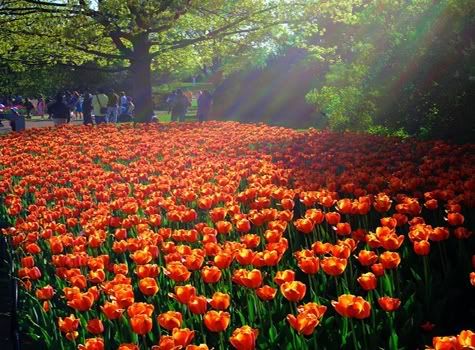
A phalanx of tulips.
Nouns also need to be precise to be effective. “The flowers bloom” is not as great as “the roses bloom.” Better yet, have the “tulips salute.” You expect flowers to bloom. Having them salute is better because it’s a fresh way of thinking of tulips, with their erect heads and stiff stems.

Overuse of adjectives and adverbs can be combated by better noun and verb choices, but some of these other parts of speech are necessary for clarity. The good thing about poetry as opposed to prose, however, is that you can accomplish much through placement. Consider:

I went to the market and picked up some chicken, which I put into the oven with potatoes and rosemary I had just picked.

Blech. Lotsa fat here. If I were to take out every junky word, it might look like this:

I went to market and bought chicken, roasted with potatoes and fresh-picked rosemary.

Some of the revision is good. “Picked up some chicken” is now just “bought chicken,” which is leaner. “Put into the oven” is simply “roasted.””Rosemary I had just picked” becomes “fresh-picked rosemary” (which might be even better as just rosemary). But “went to market” sounds British, so I think we need “the market” here in the US. Eliminating the “which” has also altered the meaning of the sentence. Did I roast the chicken myself, or did I buy it roasted already?

Here we have two conundrums. First, don’t eliminate so many junk words that the lines go from lean to stiff or unnatural. If you don’t say “go to market” or “to hospital” in your country, leave in the article. Think about style as well. Are you a minimalist? If not, you might want to retain some of the natural feel of your syntax for the sake of preserving a certain tone. Beyond that, however, note that the placement of your words on the line in poetry can accomplish some of the grammatical exigencies of prepositions, conjunctions, and other “service” words necessary in prose:

Went to the market
bought chicken
roasted with potatoes
fresh-picked rosemary.

You get it, don’t you? Because your brain is in poetry mode, it supplies the missing conjunctions. Meanwhile, the line is not watered down with tiny globs of fatcellulite.

Trimming the fat is one of the best ways to revise your poetry, and something you should consider even when you’re pretty satisfied with your draft. You can always put back some of the words you take out later if you don’t like what it does to your style. Most times, however, you will, and you’ll be surprised by how good the same words can look when they’re not surrounded by clutter. Editors don’t like clutter either. Overwriting is the mark of the insecureyou think more is better, and so you pile on the adjectives and adverbs. You think you are clarifying, but really you’re blithering. Clarity, if you’ll allow me a heinous cliché, is not a matter of quantity, but of quality. The best words in the best order, as Coleridge so wisely said.

Friday, June 3, 2011

Poetry Revision 101, Lesson Three: Arranging the Words on the Page

One of the surest markers of amateur poetry is a series of centered lines. Though I’m sure a clever poet could find a way of making such an arrangement meaningful (perhaps sarcastically?), most likely such poems are written by people whose only experience of poetry is Hallmark cards.

Before you get all cocky because you abandoned the centered lines format in your early teens, consider this: perfect iambic pentameter and/or perfectly symmetrical (not to mention left-justified) quatrains, tercets, or couplets can be just as inappropriate. That’s because the true mark of amateur poetry is not any one particular amateur format, but, rather, an inattention to format. The unskilled poet arbitrarily decides on an arrangement that seems “poetic” but does nothing else to present the content in a meaningful way.

On the other hand, the experienced poet agonizes over the arrangement of words on the page. Each poem has its own set of demands. Some poems work with short lines, some with long. Some with regular stanzas, some irregular, some with no stanza breaks at all. Some poems are left justified, some right, some even centered, and some have all types of margins. Some have metered lines, specific syllable counts, and some don’t. Some have rhyme, and some don’t. Some have punctuation, and some don’t. Some have wacky symbols, and some don’t. In some, all the lines are capitalized, and in some, none. Or all.

The careful poet makes informed choices about all of these options with each poem she writes. Understand that poetry has a visual as well as an auditory and cognitive component. Most poetry, excepting that which you hear at a reading, enters first through your eyes. Before you read each individual word, you perceive the poem as a figure on the page. The visual arrangement of words is the first impression you get of the poem, and, like all first impressions, it sets the tone for how you will interact with that poem. For example, if you see a poem arranged in symmetrical quatrains on the page, you are likely to bring a whole series of expectations to its reading associated with that classic format. The careful poet knows this and uses these expectations to create a desired effect, not a random one. If the poem, like the presentation, is traditional, the form is likely to blend in with the content and purpose of the poem, and if that is what the poet wants (for the sake of uniformity, of tradition, for whatever reason), then that is an informed choice. Another way to go with it is to use the expectations against the readerthe poem looks like a traditional sonnet, for example, but it’s really a wacky, anti-traditional poem that challenges the reader’s expectations of what formal poetry should be, like Billy Collins’s “Sonnet,” which you can read here.

Similarly, if the poem has a ragged, confusing appearance on the page, it also sets up expectations. Compare Collins’s sonnet to Adam Strauss’s “True Love,” which you can read here (Fence is freaking greatthey specialize in wacky, risk-taking poetry that really works the spacea wonderful place to learn all about this issue!). What are we to make of Strauss’s odd gaps in this poem? Immediately, you read the poem with a questioning stanceyou want to “figure it out.” Ironically, the subject of this poem is the traditional subject of the sonnet, i.e., love. But Strauss is asking us to think about being in love in the realistic sense of not being able to make sense of it, of feeling disoriented, overwhelmed, confused. He gets us on the way to this thought before we even read the first word of the poem, however, by disorienting us visually, confounding our expectations of what a poem looks like.

Moreover, lineation, stanza breaks, and any other use of white space affect not only our initial visual impression of a poem, but also its emotional climate. The spaces in Strauss’s poem disturb our traditional reading of the fairly grammatically arranged words. The sentence “John Donne probably wouldn't like me were we to meet” is fairly straightforward, but the way Strauss has arranged it on the page makes us hesitate to make sense of it in a way that a traditional arrangement would not. We feel confused, pensive, which is what Strauss wants. The sentence itself is rather ordinary, but Strauss accomplishes with placement what he can’t with words. The empty spacesbetween words, between lines, between stanzasbecome words themselves, invisible words packed with meaning and emotional charge. This is really cool!
The Art of the Poetic Line
A must-read for anyone
working on lineation.

What Strauss is doing is called annotating the line. To annotate something is to explain it. Normally, we read words in preestablished ways. If we pause in a sequence of words, we usually also do it in preestablished ways, such as at a punctuation mark like a comma or period, or between grammatical units like phrases and subordinate clauses or between subjects and verbs. A poem that follows these preexisting pauses is said to have parsing lines. For example:

Roses are red,
violets are blue,
sugar is sweet,
and so are you.

These lines are parsed, broken into grammatical units of subject, verb, and predicate adjective. Moreover, the commas would make you pause at the same spot the line break doesthere is no conflict. The lack of conflict has a specific effectit propels the poem forward. You don’t pause much at all; you are moved to continue reading until you get to the last line. You are also moved to do this by enjambment. The sentence does not end at the end of the line, but continues to the next line, so you keep reading, searching for the end of the thought. You could slow down the pace of this poem simply by switching out the punctuation so that each line would be end-stopped:

Roses are red.
Violets are blue.
Sugar is sweet.
So are you.

Look at what happens to the poem when you annotate the line, or work against the grammar and punctuation:

Roses are red. Violets
are blue, sugar is
sweet, and so
are
                              you.

This is a pretty extreme, silly example, but it makes the point. The irregular breaking of the line changes the tenor of the poem entirely. You can’t read it fastyou are forced to stop at the breaks, against your will, even. In addition, the superindenting of the last line puts a new emphasis on the word “you.” It sets it apart, highlights it like a sculpture on a pedestal. You don’t just read the word, you arrive at it.

Of course, you want to pay attention to what it is you are emphasizing with such tricks. For example, the rearrangement above doesn’t work because the highlighted words are pretty silly. What’s the point of “arriving” at the totally expected and meaningless pronoun, you? Here is where you have to learn that tricky dance between content and style, so that when you create an arrival, the destination is worth it.

These choices also work best when you can merge the visual and the auditory. The way you hear a poem in your head is very likely to reflect the emotional tone you are trying to create visually, the questioning stance or the galloping pace. How disappointing is it when someone else reads your poem aloud and it sounds nothing like it did in your head? You can manipulate the way a poem is read by manipulating space. Usually, the more white space you incorporate into the poem, the slower it will be read.

I don’t really pay attention to form when I’m drafting. In fact, I often draft quickly, in long lines or even paragraphs. My first concern is getting down the content, the words and images I want. One way to move from first draft to second (or at whichever draft the issue of form comes into play) is to record yourself reading the poem. Print out the poem, double spaced, in a big font, with no line breaks. Read and record. Then, take your printout and a pen, and mark the pauses where you hear them. This is your first draft of the lineation.

In subsequent drafts, notice any patterns that emerge, and either intensify or erase them, depending on what you want. For example, if after your reading draft, you notice that most of the lines of your poem are a certain length (either visually, syllabically, or metrically), any lines that are irregular will have more emphasis. If this is what you want, then keep the irregular lines. But if these irregular lines have no special meaning, you need to trim or fatten them, as the case may be, to erase that accidental emphasis. Any time you deviate from a pattern, you create emphasis. Emphasis must always be intentional.

Always consider stanza breaks. A poem with no stanza breaks, even a short one, reads fast. Stanzas, like paragraphs, create units of thought. You can have the content dictate the length of the stanzas, or you can try to have regular stanzas, all of the same length. Try the same poem a couple of different ways, and see what effect the differences create. Show it to a couple of good readers, too, and notice the different ways they react to different arrangements.

While you’re at it, have them read the poem aloud to you once you’ve decided on the final arrangement. Make sure your guinea pig is a good reader, however. Hardly anyone knows how to read anymore, period, much less poetry, so make sure any problems you hear are the poem’s and not the reader’s before you make any changes. Test your readers with a finished poem, yours or someone else’s. If you find someone who reads like he’s supposed to, do anything to keep him as a friend, but still test your poem with at least two readers before you edit.  Have you arranged your words effectively enough that someone else reads the poem just like it sounds in your head? Adjust as necessary.

Arrangement is one of the most difficult aspects of poetic composition, but it’s what separates the merely competent from the truly gifted. It may take several drafts to get it right, so you can’t rush it, and you must be willing to experiment with several different ways of arranging the same poem so you can see the effects produced, and control them. To focus on content and word choice alone is to miss the point of poetry, which is a language not just of words, but of silences.

Friday, May 27, 2011

Poetry Revision 101, Lesson Two: Countering the Bobblehead Reflex

When I was about 13 or so, I wrote this poem:

The Poet,
before the invention of tweezers.
Amber are the eyes of love
Through them I see a blazing fire
As I look at you with wild desire.

Topaz shine the tiger’s eyes
Before he leaps upon his prey
I will hunt you night and day
And love you till the sapphire moonlight goes away.

Like diamonds shines the morning sun
As it illuminates an onyx sky
And turn it aquamarine,
First low, then high.

The night is gone
But soon it will come,
And again they will shine,
lapis lazuli, moonstone, and diamond.


Ah, finally got that published!

It’s a testament to how satisfied I was with this poem when I wrote it that, 25 years after, I can retype it from memory. Though I have no copy of it anywhere that I’m aware of, I’m pretty sure that’s exactly how it went. To this day it remains the only poem of mine I know by heart.

The reason is obvious: the rhyme scheme is so heavy, the poem is easy to recall. That was the original function of rhyme, of course. In the days before stories were easily transmitted via print, they had to be memorized, and the rhyme prompted the lines you might have otherwise forgotten. Rhythm, meter, had the same function, and the poem above, although not perfect, has a pretty steady rhythm to it. This is also the reason why you may know so many song lyrics, and yet not a single poem. Rhyme, meter, musicall these aid recall.

But do they make for good poetry?

That, my darlings, is the question for today, and the brief answer, as my teen angst ditty so aptly reveals, is, not by themselves, no.

So here is Poetry Revision 101, lesson two: if you employ rhyme, meter, or any other formal devices in your draft, rewrite without them, and see if you still have a poem.

Let’s test this premise using my old poem. You can seequite obviously—that I attempted to “poeticize” my hormonal stirrings in as many ways as I could. I still remember finding the article on gems in my old World Book encyclopedia and copying down the list of all the gems. My goal—and I achieved it!—was to use all the gems mentioned in the article, including those, like lapis lazuli, I had never heard of at the time (imagine my distress when I eventually noticed that the article was not a definitive list, that, in fact, it oddly omitted common gems like rubies and emeralds!). Something in me had clued me in to the fact that a good poem needed to have some good content, and off I went, geek that I always have been, to the comfort of the sort-of-leather-bound World Book, where all the world’s knowledge was neatly organized alphabetically in twenty-six volumes. Hey, it was a start. What I failed to realize, however, was that making information rhyme was no more poetic than listing it alphabetically. I had a nifty concept, I had some nice SAT words, I had a good ear, but I had NO POEM. Take away all these devices, and I had a tired analogy, woman:man :: tiger:prey (did I get that from the Flashdance soundtrack???).

Such a faux pas is easy to see in a thirteen-year-old’s work, but not so easy in an adult’s. However, the difference is just a matter of degree. The adult writer can just as easily be lured into thinking a poem’s great because it sounds great, or because it has a nifty concept. This is especially easy to fall for if you’re working in form. You’ve written a classic sonnet, by golly, in perfect iambic pentameter and everything. It just rolls off the tongue like . . . well, you know. Its clever phrases haunt you like jingles. But is it any good? There’s only one way to find out.

Please note that I am not suggesting you never write in form or use rhyme and meter. That would be pretty silly. What I’m saying is that these are components of a good poem, and not enough by themselves, in the same way that a profound revelation sloppily written would not be a good poem either. A good poem must both have good content and good form. However, rhyme, in particular, is so satisfying to the ear that it can cloud even an experienced poet’s judgment. You might not notice that your content is poor or that you are employing cliché, because you are so thrilled by the sounds of your words that all your attention is taken up by your ears. Think of it as bobbing your head along to a song without listening to the lyrics. If, on the other hand, you write a test draft without rhyme, meter, or whatever other cutesy device you employed in the first draft, and you still have a good, satisfying poem, then, by all means, continue working in rhyme and meter or other devices in subsequent drafts.

Scary. I know. But you should know that a poet’s—a writer’s—worst enemy is self-satisfaction. Murder your darlings, Arthur Quiller-Couch used to say. Poems like my gem poem are often fun to write—the rhyme urges you on, and, even when you get stuck, finally finding a way to keep the poem going according to the plan can be like getting the right answer in Final Jeopardy. The poem came so easily, sounds so good—how can it not be? One thing you can do is use the shelf method. Put the poem away and don’t look at it for at least a couple of weeks. When you return to it, the initial thrill is hopefully gone, and you’ll be able to evaluate it more objectively.

Hopefully, it won’t take you twenty-five years.


Friday, May 20, 2011

Black-Eyed Peas & Quinoa Salad

As promised, today I’m participating in the 32 Poems Blog’s call for “Recipes for Poets.” I’m not a “great” cook or anything like that, but I enjoy cooking very much the same way some people enjoy shopping (which I definitely don’t!). You put together an outfit, and, though you may never wear it, it holds such promise! Surely anyone who wears an off-the-shoulder black silk dress and four-inch stilettos is part of some walking party. Or, perhaps you wear the outfit, but wind up getting blisters on your feet and being cold in the restaurant where you could just as well have worn jeans and a stretchy sweater. For a moment, however, as you turn this way and that in front of the dressing-room mirror, you’re one of The Beautiful People.

This is pretty much the way I feel about food. I spend more time than I should watching Giada de Laurentiis serve couscous appetizers in Japanese soup spoons to a small gathering of friends sitting around a white linen table oceanside, bathed in golden sunlight. There never seem to be any bugs, no one complains about the heat, no one’s on a low-carb diet. Everyone is thin and beautiful, and in between bites of crostini, they do yoga and travel to bed and breakfasts in Tuscany with their Dresden-doll toddlers, who also love crostini and arugula. Let’s not even talk about Ina Garten, who just walks outside her kitchen door to her neoclassical rows of basil and flat-leaf parsley whenever she needs them for a recipe, and serves Tuscan bean soup (and crostini) to the construction workers restoring the nearby windmill.

Blood, Bones & Butter: The Inadvertent Education of a Reluctant ChefClearly I’m not alone in my romance with food. It’s officially a genre. In fact, my current read is Gabrielle Hamilton’s food memoir, Blood, Bones & Butter: The Inadvertent Education of a Reluctant Chef. I still make a veggie version of the fried green tomato recipe in the back of Fannie Flagg’s book. I remember my husband reading me passages from Like Water for Chocolate in some kind of attempt to woo me about a thousand years and twenty pounds ago. Reading Jane Kenyon’s “Fat” and smoking Kools (I never did find Pall Malls here) after pigging out at the all-you-can-eat buffet at House of India. Diane Lockward’s What Feeds Us is an entire poetry collection exploring the relationship between food and . . . everything! What better way to tap into this vein than to cook? Think of it as ekphrasis.

Black-Eyed Peas & Quinoa Salad

Quinoa is the forgotten supergrain that many health nuts are now rediscovering. Unlike rice, it’s chock-full of protein and low in carbs. You can bring out the natural nutty flavor by toasting it before you cook it, as I do below, but it pretty much will taste like whatever you season it with. This salad is a nice picnic or barbecue side and can be served warm, room-temp, or chilled, if you want to prep ahead and refrigerate overnight. I use black-eyed peas because they’re cute, but you can substitute another bean if you like.

Salad
¾ cup uncooked quinoa, washed
¼ tsp. coriander
1 ½ cups water
1 can (15 oz) black-eyed peas, drained
1 cup each chopped parsley, green pepper, onion, and carrot
½ cup chopped fresh cilantro
¼ cup chopped fresh dill

Dressing
3 tbsp. fresh lime juice
3 tbsp. canola oil
1 tbsp. chili oil
1 tbsp. honey
¼  tsp. red chili powder
¼ tsp. garam massala
¼ tsp. lemon pepper
¼ tsp. salt

  1. In a large pan, toast the quinoa and coriander together, until the quinoa starts to pop. Add water and bring to a boil. Cover and simmer for 15 minutes.
  2. Whisk all the ingredients for the dressing together in a small bowl.
  3. Fluff the quinoa and add the remaining salad ingredients. Toss with the dressing. Serve at room temperature.

Wednesday, May 11, 2011

Please Stop Explaining: Poetry Revision 101

Don't speak
I know just what you're saying
So please stop explaining
Don't tell me cause it hurts
Don't speak
I know what you're thinking
I don't need your reasons
Don't tell me cause it hurts

—“Don’t Speak,” No Doubt


May is the perfect month to think about revision. If you wrote a bunch of poems for National Poetry Month in April, you now have a bunch of drafts and might be wondering where’s a good place to start revising. I’ve got a great one for you: stop explaining.

Mentor and Muse: Essays from Poets to PoetsIt’s not an original idea. In fact, I just read a great article about it by David Keplinger called “Hiding Your Heart’s Desire.” In my perpetual quest for the perfect poetry textbook, I just picked up Mentor and Muse: Essays from Poets to Poets. I read Keplinger’s article first because of the title, thinking it would be about combating the Hallmark monster. Instead, it’s a fine meditation/exercise (all the articles in this so far great book follow the same pattern) on the value of cutting back the explanation in your poems. Keplinger’s exercise involves choosing the two best lines in the poem and rewriting it from scratch. That sounds like fun, but first you must understand what I mean by “explanation.”

My long-time guru, William Zinsser, talks about trusting your material. This is ever more important in poetry, where we often reach for the improbable connection, the funky analogy, the bare-bones language. Will my reader understand what I mean when I talk about the tiger in my cup? Maybe I better explain I mean the whiskey in my coffee. And so, we find ourselves explaining away our poetry as if we were teaching instead of writing. The problem with explaining is that we deny the reader the pleasure of discovery. To touch back on my other guru, David Bottoms, we philosophize too much. The job of the poet, Bottoms explains, is to “make the world material on the page, so that the reader can abstract, so that the reader can take what clues the world offers and decipher meaning from them. The poet wants the reader to participate, to experience the event in a vivid way.” When we explain what we mean in a poem, it’s like we’re chewing the food for the reader. The poem is predigested, and the reader gets no flavor, no joy, no interaction. It’s like those horrible workshops where the writer keeps interrupting with “what I meant was . . . .” Like those horrible moments, explanations don’t work. Either your writing is meaningful, or it isn’t. Interpreting your own poem isn’t going to change that.

But maybe I should stop explaining.

Behold an early draft of a poem by my old student, Justin Simmons:

The Perfect House

Vintage wallpaper used to cover the walls, but even the intricacies of this baby-blue floral
pattern cannot conceal the scars and bruises left behind.

Mahogany flooring imported all the way from Argentina, but these wooden puzzle pieces cannot keep firm the foundations of this family.

A furnace used to warm the house during winter, but cannot warn the hearts of its inhabitants.

A French door made of white cedar, but for its superior wood type it cannot muffle the wails of an unhappy infant.

A thousand thread-count white linens made of the finest Egyptian cotton in an antique crib, but these white threads are no more than a rag in the eyes of a child.

Vibrant images of butterflies painted on the walls of the nursery, but the wings of these butterflies cannot carry away the sorrows of a heavyhearted child.

Toys in abundance, but these idle ornaments are unattainable to the little fingers that want to play with them.

It would appear that this is the perfect house; perfect wallpaper; perfect flooring, perfect furnace, perfect door, perfect linens, perfect paintings, and perfect toys.

This is not a bad draftthe poem contains the one thing all poems need in great abundance: stuff. The carefully chosen details are all tactile and specific: vintage wallpaper, imported flooring, white cedar. Each of the details Justin chose spoke to a whole era of fancy décor. The problem is, he didn’t trust us to understand what he means. Each detail, each line, contains an explanation, a clarification of the obvious symbolism involved. The poem is so weighed down, all a reader can do with it is discard it. The poem doesn’t let me think. The symbolism is all wrung out. Take a look at the same poem, sans the explanations:

Perfect

Vintage wallpaper used to cover the walls.
Mahogany flooring imported all the way from Argentina.
A furnace used to warm the house during winter.
A French door made of white cedar.
A thousand thread-count white linens
made of the finest Egyptian cotton in an antique crib.
Vibrant images of butterflies painted on the walls of the nursery.
Toys in abundance.

Despite being cut back to less than one third the length of the first draft, this poem now weighs much more. We are allowed to focus on each detail and its potential meanings without the distraction of chatter. Even the reduction of the title is suddenly imbued with symbolism. “The Perfect House” is explanatory, but the single word “Perfect” invites us to dwell on the concept of perfection itself, and its desirability given the obvious context of the “perfect” items in the poem. With each material detail, we notice the absence of any humans, any family, in this poemwithout having to be told. The new last line of the poem is especially impactfulsuddenly, we understand that all these things the poem has laid out before our eyes are nothing but toys, playthings with no real life. The last wordabundanceinvites further scrutiny. What sort of abundance is this? The poem is now full of irony, and chilling in its starkness. This is a great poem!

It’s one of those well-known stories teachers love to repeat: how Elie Wiesel cut the manuscript of Night from over 800 pages to less than 200. But it’s a great lesson. Another old-time trick is to envision that every word in your poem (or any kind of writing, really) is costing you money. I like to think of it as $10 a word. Really makes you think about what you need and don’t need in your poem! But it’s also a matter of envisioning your reader. To whom are you writing? Sometimes, when you’re in workshop, you’re writing to students, people who are not necessarily avid or expert readers of poetry. This exacerbates the impulse to explain. Forget them! Write to the best reader you can imagine. It might be the professor, or an editor or other poet. Reading lots of poetry yourself and lots of criticismas alwaysalso helps. This is how you learn what others are capable and not capable of “getting.” Even when you identify an image or a reference that your most expert ideal reader will not get, what you should do is revise the image or reference, and not explain the obscure one. Obscurity is bad, even if you explain it. Just don’t explain, ever.

Don't speak,
I know what you're thinking
And I don't need your reasons
I know you're good,
I know you're good,
I know you're real good.
Related Posts Plugin for WordPress, Blogger...