Showing posts with label Poetry Revision 101. Show all posts

Friday, June 10, 2011

Poetry Revision 101, Lesson Four: Do I Sound Fat in This Poem?

This post is dedicated to Dinkinish, who writes with an airbrush.

The wild roses are very red,
and the violets are dark blue,
while the sugar is extremely sweet,
as sweet as you.

Eh? Bizarre. Forgive me for using the same old rhyme to elucidate, but the familiarity of the way this is supposed to go should help you see how unnecessary words and phrases can make your poem fat.

We all know fat is the enemy. According to Market Research News, the global weightloss market will be worth 586.3 billion in US dollars by 2014. We spend money on pills, on treadmills and trainers, on diets and gurus, all trying to lose the fat. Meanwhile, your poetry might be fatter than your thighs, and much easier to fix.

There are eight parts of speech: verbs, nouns, adverbs, adjectives, pronouns, prepositions, conjunctions, and interjections. To the poet, however, these are not all equally useful (prose writers—really good ones—are equally biased, by the way). Lean writing, writing that is super-concentrated and packs a wallop of nutrition, is verb and noun based. All other parts of speech should be used only when absolutely necessary. Think of them as the carbs and fats of writing.

The opening revision is a good example. The first thing I did to plump up the rhyme was add “The wild” to “roses.” Instead of just a noun, a nice, simple noun, now we have two adjectives and a noun (articles—a, an, the—are a kind of adjective, in case you forget). Three words doing the job formerly done by one. Is the poem any better for it? No. Articles are one of the most useless of all words in poems. They clutter up your line, and have a tendency to fall at the beginning of the line, as above, which is a coveted spot. The opening word of a line has particular emphasis, and to waste it on an article is tragic. “Wild” also adds nothing here, although it might somewhere else. The result? The line is weaker, watered down. “Roses are red,” is simple, to the point. Clear. “The wild roses are very red” is unnecessarily burdened with extra fat.

Focusing on verbs—the leanest, meanest, best of words—is a good way to put your poetry on a diet. A strong, well-chosen verb can instantly drive home meaning. Consider:

I felt the blackness closing in on me
and made my way to the nearest chair,
where I sat down heavily and tried
to regain my breath. (27 words)

I wilted and collapsed
into a chair, panting. (8 words)

Which lines grab you more? The first four lines are wordy, fat. The last two are immediate, striking. “Felt the blackness closing in on me” is not only a cliché, it’s imprecise. The one word—wilted—immediately conveys the sensation in a fresher way. “Made my way to the nearest chair, where I sat down heavily” is especially flabby. Why do people “make their way” anywhere, anyway? Don’t they just “go”? Better yet, skip to what’s important, and just get there. Does it matter that it’s the “nearest” chair? “Sat down heavily” is weak verb + adverb + adverb. You mean collapsed, which is the best kind of verb, an action verb. “Sat” is also an action verb, but it’s plain. “Collapsed” combines both the action and the description of the action—heavily—into one effective verb. Not all verbs are equal. “Felt,” for example, is not a great verb. I felt sick or I was sick is not as great as I barfed. Don’t “feel” sick or “think you might be” sick or “suspect you are” sick. Barf. Retch. Vomit.
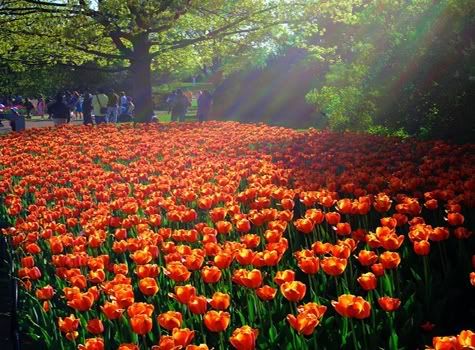
A phalanx of tulips.
Nouns also need to be precise to be effective. “The flowers bloom” is not as great as “the roses bloom.” Better yet, have the “tulips salute.” You expect flowers to bloom. Having them salute is better because it’s a fresh way of thinking of tulips, with their erect heads and stiff stems.

Overuse of adjectives and adverbs can be combated by better noun and verb choices, but some of these other parts of speech are necessary for clarity. The good thing about poetry as opposed to prose, however, is that you can accomplish much through placement. Consider:

I went to the market and picked up some chicken, which I put into the oven with potatoes and rosemary I had just picked.

Blech. Lotsa fat here. If I were to take out every junky word, it might look like this:

I went to market and bought chicken, roasted with potatoes and fresh-picked rosemary.

Some of the revision is good. “Picked up some chicken” is now just “bought chicken,” which is leaner. “Put into the oven” is simply “roasted.””Rosemary I had just picked” becomes “fresh-picked rosemary” (which might be even better as just rosemary). But “went to market” sounds British, so I think we need “the market” here in the US. Eliminating the “which” has also altered the meaning of the sentence. Did I roast the chicken myself, or did I buy it roasted already?

Here we have two conundrums. First, don’t eliminate so many junk words that the lines go from lean to stiff or unnatural. If you don’t say “go to market” or “to hospital” in your country, leave in the article. Think about style as well. Are you a minimalist? If not, you might want to retain some of the natural feel of your syntax for the sake of preserving a certain tone. Beyond that, however, note that the placement of your words on the line in poetry can accomplish some of the grammatical exigencies of prepositions, conjunctions, and other “service” words necessary in prose:

Went to the market
bought chicken
roasted with potatoes
fresh-picked rosemary.

You get it, don’t you? Because your brain is in poetry mode, it supplies the missing conjunctions. Meanwhile, the line is not watered down with tiny globs of fat—cellulite.

Trimming the fat is one of the best ways to revise your poetry, and something you should consider even when you’re pretty satisfied with your draft. You can always put back some of the words you take out later if you don’t like what it does to your style. Most times, however, you will, and you’ll be surprised by how good the same words can look when they’re not surrounded by clutter. Editors don’t like clutter either. Overwriting is the mark of the insecure—you think more is better, and so you pile on the adjectives and adverbs. You think you are clarifying, but really you’re blithering. Clarity, if you’ll allow me a heinous cliché, is not a matter of quantity, but of quality. The best words in the best order, as Coleridge so wisely said.

Friday, June 3, 2011

Poetry Revision 101, Lesson Three: Arranging the Words on the Page

One of the surest markers of amateur poetry is a series of centered lines. Though I’m sure a clever poet could find a way of making such an arrangement meaningful (perhaps sarcastically?), most likely such poems are written by people whose only experience of poetry is Hallmark cards.

Before you get all cocky because you abandoned the centered lines format in your early teens, consider this: perfect iambic pentameter and/or perfectly symmetrical (not to mention left-justified) quatrains, tercets, or couplets can be just as inappropriate. That’s because the true mark of amateur poetry is not any one particular amateur format, but, rather, an inattention to format. The unskilled poet arbitrarily decides on an arrangement that seems “poetic” but does nothing else to present the content in a meaningful way.

On the other hand, the experienced poet agonizes over the arrangement of words on the page. Each poem has its own set of demands. Some poems work with short lines, some with long. Some with regular stanzas, some irregular, some with no stanza breaks at all. Some poems are left justified, some right, some even centered, and some have all types of margins. Some have metered lines, specific syllable counts, and some don’t. Some have rhyme, and some don’t. Some have punctuation, and some don’t. Some have wacky symbols, and some don’t. In some, all the lines are capitalized, and in some, none. Or all.

The careful poet makes informed choices about all of these options with each poem she writes. Understand that poetry has a visual as well as an auditory and cognitive component. Most poetry, excepting that which you hear at a reading, enters first through your eyes. Before you read each individual word, you perceive the poem as a figure on the page. The visual arrangement of words is the first impression you get of the poem, and, like all first impressions, it sets the tone for how you will interact with that poem. For example, if you see a poem arranged in symmetrical quatrains on the page, you are likely to bring a whole series of expectations to its reading associated with that classic format. The careful poet knows this and uses these expectations to create a desired effect, not a random one. If the poem, like the presentation, is traditional, the form is likely to blend in with the content and purpose of the poem, and if that is what the poet wants (for the sake of uniformity, of tradition, for whatever reason), then that is an informed choice. Another way to go with it is to use the expectations against the reader—the poem looks like a traditional sonnet, for example, but it’s really a wacky, anti-traditional poem that challenges the reader’s expectations of what formal poetry should be, like Billy Collins’s “Sonnet,” which you can read here.

Similarly, if the poem has a ragged, confusing appearance on the page, it also sets up expectations. Compare Collins’s sonnet to Adam Strauss’s “True Love,” which you can read here (Fence is freaking great—they specialize in wacky, risk-taking poetry that really works the space—a wonderful place to learn all about this issue!). What are we to make of Strauss’s odd gaps in this poem? Immediately, you read the poem with a questioning stance—you want to “figure it out.” Ironically, the subject of this poem is the traditional subject of the sonnet, i.e., love. But Strauss is asking us to think about being in love in the realistic sense of not being able to make sense of it, of feeling disoriented, overwhelmed, confused. He gets us on the way to this thought before we even read the first word of the poem, however, by disorienting us visually, confounding our expectations of what a poem looks like.

Moreover, lineation, stanza breaks, and any other use of white space affect not only our initial visual impression of a poem, but also its emotional climate. The spaces in Strauss’s poem disturb our traditional reading of the fairly grammatically arranged words. The sentence “John Donne probably wouldn't like me were we to meet” is fairly straightforward, but the way Strauss has arranged it on the page makes us hesitate to make sense of it in a way that a traditional arrangement would not. We feel confused, pensive, which is what Strauss wants. The sentence itself is rather ordinary, but Strauss accomplishes with placement what he can’t with words. The empty spaces—between words, between lines, between stanzas—become words themselves, invisible words packed with meaning and emotional charge. This is really cool!
The Art of the Poetic Line
A must-read for anyone
working on lineation.

What Strauss is doing is called annotating the line. To annotate something is to explain it. Normally, we read words in preestablished ways. If we pause in a sequence of words, we usually also do it in preestablished ways, such as at a punctuation mark like a comma or period, or between grammatical units like phrases and subordinate clauses or between subjects and verbs. A poem that follows these preexisting pauses is said to have parsing lines. For example:

Roses are red,
violets are blue,
sugar is sweet,
and so are you.

These lines are parsed, broken into grammatical units of subject, verb, and predicate adjective. Moreover, the commas would make you pause at the same spot the line break does—there is no conflict. The lack of conflict has a specific effect—it propels the poem forward. You don’t pause much at all; you are moved to continue reading until you get to the last line. You are also moved to do this by enjambment. The sentence does not end at the end of the line, but continues to the next line, so you keep reading, searching for the end of the thought. You could slow down the pace of this poem simply by switching out the punctuation so that each line would be end-stopped:

Roses are red.
Violets are blue.
Sugar is sweet.
So are you.

Look at what happens to the poem when you annotate the line, or work against the grammar and punctuation:

Roses are red. Violets
are blue, sugar is
sweet, and so
are
                              you.

This is a pretty extreme, silly example, but it makes the point. The irregular breaking of the line changes the tenor of the poem entirely. You can’t read it fast—you are forced to stop at the breaks, against your will, even. In addition, the superindenting of the last line puts a new emphasis on the word “you.” It sets it apart, highlights it like a sculpture on a pedestal. You don’t just read the word, you arrive at it.

Of course, you want to pay attention to what it is you are emphasizing with such tricks. For example, the rearrangement above doesn’t work because the highlighted words are pretty silly. What’s the point of “arriving” at the totally expected and meaningless pronoun, you? Here is where you have to learn that tricky dance between content and style, so that when you create an arrival, the destination is worth it.

These choices also work best when you can merge the visual and the auditory. The way you hear a poem in your head is very likely to reflect the emotional tone you are trying to create visually, the questioning stance or the galloping pace. How disappointing is it when someone else reads your poem aloud and it sounds nothing like it did in your head? You can manipulate the way a poem is read by manipulating space. Usually, the more white space you incorporate into the poem, the slower it will be read.

I don’t really pay attention to form when I’m drafting. In fact, I often draft quickly, in long lines or even paragraphs. My first concern is getting down the content, the words and images I want. One way to move from first draft to second (or at whichever draft the issue of form comes into play) is to record yourself reading the poem. Print out the poem, double spaced, in a big font, with no line breaks. Read and record. Then, take your printout and a pen, and mark the pauses where you hear them. This is your first draft of the lineation.

In subsequent drafts, notice any patterns that emerge, and either intensify or erase them, depending on what you want. For example, if after your reading draft, you notice that most of the lines of your poem are a certain length (either visually, syllabically, or metrically), any lines that are irregular will have more emphasis. If this is what you want, then keep the irregular lines. But if these irregular lines have no special meaning, you need to trim or fatten them, as the case may be, to erase that accidental emphasis. Any time you deviate from a pattern, you create emphasis. Emphasis must always be intentional.

Always consider stanza breaks. A poem with no stanza breaks, even a short one, reads fast. Stanzas, like paragraphs, create units of thought. You can have the content dictate the length of the stanzas, or you can try to have regular stanzas, all of the same length. Try the same poem a couple of different ways, and see what effect the differences create. Show it to a couple of good readers, too, and notice the different ways they react to different arrangements.

While you’re at it, have them read the poem aloud to you once you’ve decided on the final arrangement. Make sure your guinea pig is a good reader, however. Hardly anyone knows how to read anymore, period, much less poetry, so make sure any problems you hear are the poem’s and not the reader’s before you make any changes. Test your readers with a finished poem, yours or someone else’s. If you find someone who reads like he’s supposed to, do anything to keep him as a friend, but still test your poem with at least two readers before you edit.  Have you arranged your words effectively enough that someone else reads the poem just like it sounds in your head? Adjust as necessary.

Arrangement is one of the most difficult aspects of poetic composition, but it’s what separates the merely competent from the truly gifted. It may take several drafts to get it right, so you can’t rush it, and you must be willing to experiment with several different ways of arranging the same poem so you can see the effects produced, and control them. To focus on content and word choice alone is to miss the point of poetry, which is a language not just of words, but of silences.

Friday, May 27, 2011

Poetry Revision 101, Lesson Two: Countering the Bobblehead Reflex

When I was about 13 or so, I wrote this poem:

The Poet,
before the invention of tweezers.
Amber are the eyes of love
Through them I see a blazing fire
As I look at you with wild desire.

Topaz shine the tiger’s eyes
Before he leaps upon his prey
I will hunt you night and day
And love you till the sapphire moonlight goes away.

Like diamonds shines the morning sun
As it illuminates an onyx sky
And turn it aquamarine,
First low, then high.

The night is gone
But soon it will come,
And again they will shine,
lapis lazuli, moonstone, and diamond.


Ah, finally got that published!

It’s a testament to how satisfied I was with this poem when I wrote it that, 25 years after, I can retype it from memory. Though I have no copy of it anywhere that I’m aware of, I’m pretty sure that’s exactly how it went. To this day it remains the only poem of mine I know by heart.

The reason is obvious: the rhyme scheme is so heavy, the poem is easy to recall. That was the original function of rhyme, of course. In the days before stories were easily transmitted via print, they had to be memorized, and the rhyme prompted the lines you might have otherwise forgotten. Rhythm, meter, had the same function, and the poem above, although not perfect, has a pretty steady rhythm to it. This is also the reason why you may know so many song lyrics, and yet not a single poem. Rhyme, meter, music—all these aid recall.

But do they make for good poetry?

That, my darlings, is the question for today, and the brief answer, as my teen angst ditty so aptly reveals, is, not by themselves, no.

So here is Poetry Revision 101, lesson two: if you employ rhyme, meter, or any other formal devices in your draft, rewrite without them, and see if you still have a poem.

Let’s test this premise using my old poem. You can see—quite obviously—that I attempted to “poeticize” my hormonal stirrings in as many ways as I could. I still remember finding the article on gems in my old World Book encyclopedia and copying down the list of all the gems. My goal—and I achieved it!—was to use all the gems mentioned in the article, including those, like lapis lazuli, I had never heard of at the time (imagine my distress when I eventually noticed that the article was not a definitive list, that, in fact, it oddly omitted common gems like rubies and emeralds!). Something in me had clued me in to the fact that a good poem needed to have some good content, and off I went, geek that I always have been, to the comfort of the sort-of-leather-bound World Book, where all the world’s knowledge was neatly organized alphabetically in twenty-six volumes. Hey, it was a start. What I failed to realize, however, was that making information rhyme was no more poetic than listing it alphabetically. I had a nifty concept, I had some nice SAT words, I had a good ear, but I had NO POEM. Take away all these devices, and I had a tired analogy, woman:man :: tiger:prey (did I get that from the Flashdance soundtrack???).

Such a faux pas is easy to see in a thirteen-year-old’s work, but not so easy in an adult’s. However, the difference is just a matter of degree. The adult writer can just as easily be lured into thinking a poem’s great because it sounds great, or because it has a nifty concept. This is especially easy to fall for if you’re working in form. You’ve written a classic sonnet, by golly, in perfect iambic pentameter and everything. It just rolls off the tongue like . . . well, you know. Its clever phrases haunt you like jingles. But is it any good? There’s only one way to find out.

Please note that I am not suggesting you never write in form or use rhyme and meter. That would be pretty silly. What I’m saying is that these are components of a good poem, and not enough by themselves, in the same way that a profound revelation sloppily written would not be a good poem either. A good poem must both have good content and good form. However, rhyme, in particular, is so satisfying to the ear that it can cloud even an experienced poet’s judgment. You might not notice that your content is poor or that you are employing cliché, because you are so thrilled by the sounds of your words that all your attention is taken up by your ears. Think of it as bobbing your head along to a song without listening to the lyrics. If, on the other hand, you write a test draft without rhyme, meter, or whatever other cutesy device you employed in the first draft, and you still have a good, satisfying poem, then, by all means, continue working in rhyme and meter or other devices in subsequent drafts.

Scary. I know. But you should know that a poet’s—a writer’s—worst enemy is self-satisfaction. Murder your darlings, Arthur Quiller-Couch used to say. Poems like my gem poem are often fun to write—the rhyme urges you on, and, even when you get stuck, finally finding a way to keep the poem going according to the plan can be like getting the right answer in Final Jeopardy. The poem came so easily, sounds so good—how can it not be? One thing you can do is use the shelf method. Put the poem away and don’t look at it for at least a couple of weeks. When you return to it, the initial thrill is hopefully gone, and you’ll be able to evaluate it more objectively.

Hopefully, it won’t take you twenty-five years.


Related Posts Plugin for WordPress, Blogger...